

Duration
19 Days

Everest Three High Passes Trek


Trip Grade
Difficult
Group Size
1-16 People
Max Altitude
5,550m. / 18,209ft.
Best Season
Feb- May/ Sept- Nov
Activity
Trekking and Hiking
Meals
Breakfast, Lunch & Dinner
Accommodation
Hotels & Teahouses
Transportation
Private Vehicle & Flight
Trip Customization
On request (click here)


Highlights of Everest Three High Passes Trek
- Explore three of the most famous Himalayanpasses through Kongma La (5,528 m / 18,136 ft), Cho La (5,368 m / 17,611 ft), and Renjo La (5,360 m / 17,585 ft).
- Visit Everest Base Camp, the best-known starting point of the Everest Expedition.
- Watch a spectacular sunrise of Mount Everest at Kala Patthar, one of the finest viewpoints in the Himalayas.
- See the beautiful turquoise-coloured Gokyo Lakes between glaciers and high mountains.
- Explore the busy Sherpa town of Namche Bazaar, the entry point to the Everest region.
- Get to see the real Sherpa culture and travel to the old mountain villages such as Khumjung.
- See magnificent Himalayan peaks such as Everest, Lhotse, Makalu, Cho Oyu, and AmaDablam on the way.
- See the Everest range and the NgozumpaGlacier in a breathtaking panorama fromGokyo Ri.
Trip Introduction
The Everest Three High Passes Trek is one of the most exciting and complete trekking adventures in the Everest region of Nepal. The journey goes through Sherpa villages, valleys between mountains, glaciers, and three renowned Himalayan passes. The trekkers visit places like Namche Bazaar at 3,446 m (11,306 ft), Dingboche at 4,360 m (14,304 ft), Everest Base Camp at 5,364 m (17,598 ft), and picturesque Gokyo Lakes, 4,800 m (15,748 ft).
On the route, there are three very difficult mountain passes, known as the Kongma La, Cho La, and Renjo La, with each elevation of over 5,300 m (17,388 ft). These passes are high, and hence make the Everest Three High Passes Trek one of the most adventurous trekking routes in the Himalayas.
It is an adventure trek that any seasoned trekker will enjoy since it is more than the usual Everest Base Camp trip. The Pass provides spectacular mountain scenery, such as Everest, Lhotse, Makalu, AmaDablam, and Cho Oyu. The Khumbu region offers trekkers a walk through the forests, suspension bridges, glaciers, and typical Sherpa settlements as they experience the culture of the region.
Since the journey goes to extremely high altitudes, the effective acclimatization in places like Namche Bazaar and Dingboche will assist trekkers to adapt safely before passing the high passes.
The highlight of the Everest Three High Passes Trek is the landscape diversity. One day you can be walking next to Khumbu Glacier at Lobuche at 4,940 m (16,207 ft), and the next day you can be standing on a viewpoint of Kala Patthar at 5,545 m (18,192 ft) looking at the sunrise over Mount Everest. The trek is an adventure and cultural experience with breathtaking views that every person eager to hike high trails and encounter tough roads will never forget.
Through proper planning, an expert guide, and a well-constructed itinerary, this amazing adventure isnot only safe but also a rewarding experience. Himalayan Adventure Treks conducts the Everest Three High Passes Trek that is well guided, with adequate acclimatization time and convenient lodge bookings in such a way that the trekkers can concentrate on the adventure and the beauty of the Everest region.
Outline Itinerary of Everest Three High Passes Trek
Day 01: Arrive in Kathmandu and meet the team
Day 02: Fly to Lukla and trek to Phakding
Day 03: Trek to Namche Bazaar, gateway of Khumbu
Day 04: Acclimatization hike to Khumjung and Hotel Everest View
Day 05: Trek from Namche to Tengboche
Day 06: Trek to Dingboche through the ImjaKhola valley
Day 07: Rest and acclimatization in Dingboche
Day 08: Trek to Chhukung and climb Chhukung Ri
Day 09: Cross Kongma La Pass and trek to Lobuche
Day 10: Trek to Gorakshep and visit Everest Base Camp
Day 11: Climb Kala Patthar and trek to Dzongla
Day 12: Cross Cho La Pass and reach Thangnag Kharka
Day 13: Walk to Gokyo Lake via glacier landscapes
Day 14: Explore Gokyo and climb Gokyo Ri
Day 15: Cross Renjo La Pass and trek down to Marlung
Day 16: Trek back to Namche Bazaar
Day 17: Final trek to Lukla
Day 18: Fly back to Kathmandu and enjoy a farewell evening
Day 19: Departure from Kathmandu
Our guests sharing their experiences (Photo/Video Gallery)


Detail itinerary of Everest Three High Passes Trek
01
Day 01: Arrive in Kathmandu and meet the team
You land at Kathmandu, the capital city of Nepal, at Tribhuvan International Airport. Upon landing, our team from the Himalayan Adventure Treks welcomes you and takes you to the hotel in the city. Kathmandu is located at 1,402 m (4,600 ft), and it is the first place where you can see the culture and hustle of Nepal.
Once checked into the hotel, you are able to take a rest and relax after your trip. Later in the day, you are introduced to your trekking guide, who has a briefing session on the Everest Three High Passes Trek. Your guide will check your equipment, make sure you have a flight to Lukla, and answer any last-minute questions you may have about the trek.
Relax throughout the evening, drink as much water as you can, and get ready to have a good adventure tomorrow.

Activity: Airport pickup and briefing, 45 min

Max. Altitude: 1,402m/4,600ft. Kathmandu

Accommodation: Hotel
02
Day 02: Fly to Lukla and trek to Phakding
This day begins with a picturesque mountain flight to Lukla. The airstrip at Lukla is small and is located at 2,860 m (9,383 ft), and is the point where your trek starts.
Once you have met the porter team and arranged the loads at Lukla, you start walking on the DudhKosi River valley. The road is mild and predominantly downhill, and it is better to warm up your legs on this day.
On your way, you are going to encounter colored prayer wheels, mani stones, and even little villages. Your walk is supported by the peace of the river. In a few hours of light walking, you arrive at the village of Phakding, at 2,610 m (8,563 ft). Here you stay in a warm lodge, have a pleasant dinner, and sleep.
Activity: Flight and trek, 4 hrs
Max. Altitude: 2,860m/9,383ft. Phakding

Meal: Breakfast, Lunch & Dinner
Accommodation: Teahouse
03
Day 03: Trek to Namche Bazaar, gateway of Khumbu
Today, you go along the Dudh Koshi River in pine forests and Sherpa villages. The path cuts across a number of long suspension bridges adorned with prayer flags. Slowly, the road starts ascending towards the gate leading to Sagarmatha National Park. Upon inspection of permits, you proceed to trek through a picturesque valley.
The last part is an uninterrupted hike up to Namche Bazaar at 3,446 m (11,306 ft). Today, the altitude increase is great, and this means that your guide will insist on a steady and gradual pace.
The main trading center of the Khumbu region is Namche, which has the form of a natural amphitheater. Once at the lodge, you can rest or do a little walk within the village and have a view of the mountains within it.
Activity: Trek, 7 hours
Max. Altitude: 3,446m/11,306ft. Namche Bazaar
Meal: Breakfast, Lunch & Dinner
Accommodation: Teahouse
04
Day 04: Acclimatization hike to Khumjung and Hotel Everest View
This is a significant acclimatization day to get your body to adjust to a higher altitude. You hike up after breakfast, out of Namche, to the well-known Hotel Everest View. This place is located at approximately 3,880 m (12,730 ft) and provides one of the first clear views of Mount Everest. During clear days, you may also observe mountains such as Ama Dablam, Lhotse, and Thamserku.
Once you have admired the scenery, you proceed to Khumjung village at 3,790 m (12,434 ft), comprising a serene Sherpa village that has a monastery and old-fashioned stone houses. You take up some time in the village and get to know some culture there.
In the afternoon, you walk down to Namche Bazaar again later in the afternoon and this gives your body time to adjust as your body sleeps at a relatively lower level.
Activity: Acclimatization hike, 5 hours
Max. Altitude: 3,880m/12,730ft. Hotel Everest View
Meal: Breakfast, Lunch & Dinner
Accommodation: Teahouse
05
Day 05: Trek from Namche to Tengboche
When you leave Namche Bazaar, you take a picturesque trailthat ascends softly up the mountainside. When it is clear, the route provides wonderful views of Everest, Lhotse, and Ama Dablam. Some hours later, the path leads down to a steep hill to the Dudh Koshi River at 3,250 m (10,663 ft).
From the river, you start on a gradual increase through rhododendron and juniper forests to Tengboche. Mule caravans and yaks oftentimes trail. After some time, you come to Tengboche village, which is 3,860 m (12,664 ft). The village is also known for the Tengboche Monastery, which is the biggest monastery in the Khumbu region.
You can also go to the monastery and attend evening prayers if you come at the right time. The beauty of the surrounding environment and the calmness of the place make it a memorable experience.
Activity: Trek, 6 hours
Max. Altitude: 3,860m/12,664ft. Tengboche
Meal: Breakfast, Lunch & Dinner
Accommodation: Teahouse
06
Day 06: Trek to Dingboche through the ImjaKhola valley
You then start down, after breakfast, from Tengboche, through a wooded path, to the Imja Khola River. Landscape is gradually transformed to have fewer trees and a more open Alpine landscape. You go through small villages along the way, like Pangboche with its 3,985 m (13, 074 ft) elevation and being one of the oldest Sherpa settlements in the area.
This path then runs off across broad valleys and fields bordered by stone walls where they grow barley and potatoes. On sunny days, the beautiful peak of Ama Dablam stands out in the skyline. It is a gradual hike, but several hours later, you are in the village of Dingboche at 4,360 m (14,304 ft).
Dingboche is a village located in a broad valley with breathtaking mountain ranges, and offers a perfect site to acclimatize to high altitude.
Activity: Trek, 6 hours
Max. Altitude: 4,360m/14,304ft. Dingboche
Meal: Breakfast, Lunch & Dinner
Accommodation: Teahouse
07
Day 07: Rest and acclimatization in Dingboche
The other acclimatizing day is today, and it will assist your body to become accustomed to the rising altitude. At 4,360 m (14,304 ft),Dingboche, a day here will make the higher parts of the trail safer and more comfortable.
You have a little hike in the morning, to one of the ridges or to a viewpoint above the village. This walk enables you to elevate to greater heights and then come down to sleep again at a lower elevation, assisting in acclimatization. The views of peaks like Ama Dablam and Island Peak are wide and can be seen around the ridges.
You go back to Dingboche so that you can have lunch and rest. During the afternoon, you might go sightseeing in the village, rest at the lodge, and get ready for the next few high-altitude trekking days.
Activity: Short hike and rest, 3 hours
Max. Altitude: 4,360m/14,304ft. Dingboche
Meal: Breakfast, Lunch & Dinner
Accommodation: Teahouse
08
Day 08: Trek to Chhukung and climb Chhukung Ri
Now you walk to Chhukung, a small village in a dramatic valley of the glaciers. The path continues to ascend slowly, accompanied by open scenery and massive hills. Chhukung has an elevation of 4,730 m (15,518 ft) and boasts magnificent scenery of the mountains and glaciers.
Once in the village and having a brief rest, you start the trek to the Chhukung Ri, which is a common viewpoint summit. The ascent is quite steep and needs to be paced because the elevation is very high.
Finally, you arrive at the top of Chhukung Ri 5,546 m (18,196 ft), where one can see the Himalayas in every direction. The top has a view of Island Peak, Makalu, and various glaciers.
Once you are done with the views, you go down slowly to Chhukung, and you get to sleep.
Activity: Trek and summit hike, 7 hours
Max. Altitude: 5,546m/18,196ft. Chhukung Ri
Meal: Breakfast, Lunch & Dinner
Accommodation: Teahouse
09
Day 09: Cross Kongma La Pass and trek to Lobuche
This day is among the most difficult and the most rewarding days of the trek. You get up early morning, and you start the climb to the Kongma La Pass. It is a rocky, steep trail, and the high altitude requires slow and cautious movement.
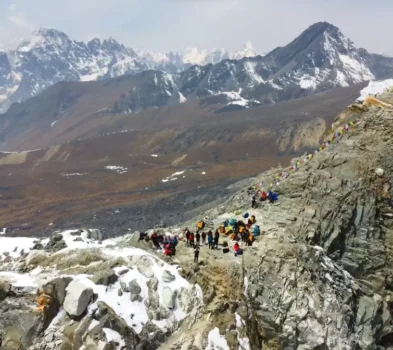
After several hours of continuous ascending, you arrive at the summit of Kongma La Pass at 5,528 m (18,136 ft). The views of the glaciers, ice-filled valleys, and the Himalayan surrounding peaks are dramatic and can be viewed from the pass. When you have had enough sightseeing, you then start a gradual slide down through the rocks.
The path ultimately reaches Khumbu Glacier and goes to the Lobuche village at 4,940 m (16,207 ft). This is a tedious day that offers you some of the most impressive mountain scenery of the whole trek.
Activity: High-pass crossing trek, 7 hours
Max. Altitude: 5,528m/18,136ft. Kongma La pass
Meal: Breakfast, Lunch & Dinner
Accommodation: Teahouse
10
Day 10: Trek to Gorakshep and visit Everest Base Camp
You are walking all day today up the rocky stages on either side of the Khumbu Glacier. The scenery turns rugged towards Gorakshep at 5,164 m (16,942 ft). Upon arrival, you have lunch and have a short rest, then you move on to Everest Base Camp.
The route takes the path along the rim of the glacier with spectacular scenery of ice groups and neighboring mountains. To take a walk up here, one has to take their steps carefully and gradually. Then, you arrive at Everest Base Camp 5,364 m (17,598 ft), which is a popular tourist spot where mountaineers train to climb the summit. You are taking photos, and you are in a strong mountain mood.
Having spent some time there, you come back to Gorakshep for the night and have a nice meal at the lodge.
Activity: Trek and base camp hike, 7 hours
Max. Altitude: 5,364m/17,598ft. EBC
Meal: Breakfast, Lunch & Dinner
Accommodation: Teahouse
11
Day 11: Climb Kala Patthar and trek to Dzongla
You get up before sunrise and get ready to climb a difficult ridge, Kala Patthar. The mountain path takes one to a viewpoint of 5,545 m (18,192 ft), one of the best places to view Mount Everest and other surrounding peaks in the early morning light.
You see the beautiful sunrise, and you come down to Gorakshep at 5,164 m (16,942 ft) to have breakfast. You carry on with your trekking later on to Dzongla.
The road is through mountainous slopes and glacial landscapes with extensive mountain views. The breathing is also tough, and that is why your guide should recommend a steady and slow pace.
Several hours later, you arrive at the peaceful village of Dzongla at 4,830 m (15,846 ft) and sleep and get ready to cross the Cho La Pass the next day.
Activity: Sunrise hike and trek, 9 hours
Max. Altitude: 5,545m/18,192ft. KalaPatthar
Meal: Breakfast, Lunch & Dinner
Accommodation: Teahouse
12
Day 12: Cross Cho La Pass and reach Thangnag Kharka
It is one of the most exquisite days of the trek. You leave Dzongla and start climbing to the Cho LaPass. The path is steep and climbs rocky mountains and at parts traverses icy surfaces, hence caution is necessary. The higher you go, the more dramatic the views are.
You arrive at Cho LaPass, 5,368 m (17,611 ft), and there are colorful prayer flags. It is a good place to have a beautiful view of other peaks and glaciers. Having clicked some photos and taken a short rest, you start the descent to Thangnag Kharka.
The road passes glacial terrain and is then joined by a valley settlement at 4,700 m (15,420 ft). Being exhausted after a hard and tiring day, you rest at the lodge and have a warm meal.
Activity: High-pass crossing trek, 7 hours
Max. Altitude: 5,368m/17,612ft. Cho La pass
Meal: Breakfast, Lunch & Dinner
Accommodation: Teahouse
13
Day 13: Walk to Gokyo Lake via glacier landscapes
The journey on this day is shorter and gives your body time to rest after your arduous pass crossing. Leaving Thangnag Kharkaat 4,700 m (15,420 ft), the path passes along a broad valley, and the glaciers and rocky hills can be seen.
The trail goes across the Ngozumpa Glacier, which is the biggest glacier in the Himalaya. To cross the glacier, one has to take consistent strides on uneven surfaces. Once across, the path slowly ascends to the Gokyo Valley.
Then, shortly, you are at the smooth turquoise waters of Gokyo Lake at 4,800 m (15,748 ft). The snow-capped mountains all around and the calm atmosphere make for a very special atmosphere. You spend the afternoon by the side of the lake in the peaceful mountain setting.
Activity: Trek, 4 hours
Max. Altitude: 4,800m/15,748ft. Gokyo Lake
Meal: Breakfast, Lunch & Dinner
Accommodation: Teahouse
14
Day 14: Explore Gokyo and climb Gokyo Ri
It is an exploration and acclimatization day in the beautiful valley of Gokyo. In the morning, you ascend Gokyo Ri, a renowned viewpoint which overlooks the lake. It is not an easy route, andit will pay off in breathtaking views at the summit, which is 5,357 m (17,575 ft).
From the top, one can see Everest, Lhotse, Makalu, Cho Oyu, and the long Ngozumpa Glacier. You then go back to the Gokyo village at 4,800 m (15,748 ft) after savoring the panoramic views and having breakfast.
Later on, in the afternoon, you can walk around the quiet turquoise lakes around, the fourth and the fifth Gokyo lakes, provided time and weather permit. This leisurely day allows the body to rest and yet see the beauty of the Himalayas.
Activity: Viewpoint hike and lake exploration, 4 hours
Max. Altitude: 5,357m/17,575ft. Gokyo Ri
Meal: Breakfast, Lunch & Dinner
Accommodation: Teahouse
15
Day 15: Cross Renjo La Pass and trek down to Marlung
You start early, as we have the last high pass on the trail today. The path ascends evenly up from Gokyo to Renjo La Pass. The higher you go, the better the view of Gokyo Lakes and other peaks around.
After some time, you are on the summit of Renjo La Pass at 5,360 m (17,585 ft). It is here that you can view Everest and numerous other Himalayan mountains that spread out on the horizon. When you are done resting and taking photos, you start the long descent to the valley of Marlung.
The air is less dense as you go down, and walking is less difficult. The trail crosses small stone houses and yak pastures, and then at 4,210 m (13,812 ft), you arrive at Marlung village, where you stay the night.
Activity: High-pass crossing trek, 8 hours
Max. Altitude: 5,360m/17,585ft. Renjo La Pass
Meal: Breakfast, Lunch & Dinner
Accommodation: Teahouse
16
Day 16: Trek back to Namche Bazaar
You are going down through the Bhote Koshi valley today. The path cuts across small Sherpa villages and mountain scenery. You lose the rocky alpine landscape, and as you walk further down, trees and greenery start appearing once more, much to your relief after several days of rocky mountain top landscape.
You go through the valley pathway with stops in villages like Thame at 3,820 m (12,533 ft), which is a typical Sherpa village of cultural significance to the Khumbu region.
After a few hours of walking, the well-known town of Namche Bazaar comes into view. Namche is located at 3,446 m (11,306 ft) and provides nice accommodations, bakeries, and stores. When you have arrived at your lodge, you can have a rest, a warm meal, and congratulate yourself on this great milestone of the trek.
Activity: Trek, 6 hours
Max. Altitude: 3,446m/11,306ft. Namche Bazaar
Meal: Breakfast, Lunch & Dinner
Accommodation: Teahouse
17
Day 17: Final trek to Lukla
This is the last day of your Everest Three High Passes Trek in the Everest region. You have left Namche Bazaar and follow along the old paths through the bushes and small hamlets. The trail passes over some suspension bridges adorned with prayer flags over the Dudh Koski river.
On the route, there are villages, like Phakding, at 2,610 m (8,563 ft), where you can have lunch and take a rest. The trail then proceeds with mild ascending and descending up and down pine forests and by the sides of rivers.
You eventually get back into Lukla at 2,860 m (9,383 ft), where your trek started. During the evening, you come together with your guide and porters to celebrate the completion of the Everest Three High Passes Trek and have a farewell dinner together.
Activity: Trek, 7 hours
Max. Altitude: 2,860m/9,383ft. Lukla
Meal: Breakfast, Lunch & Dinner
Accommodation: Teahouse
18
Day 18: Fly back to Kathmandu and enjoy a farewell evening
You have breakfast in Lukla, after which you walk to the tiny mountain airport and wait to be picked up for your flight back. The flight is a short one that takes you to Kathmandu at 1,400 m (4,593 ft) from Luklaat 2,860 m (9,383 ft).
During the flight that takes approximately 35 minutes, you get to enjoy great aerial views of the hills, rivers, and the Himalayan peaks.
Once you land in Kathmandu, you are driven to your hotel, where you can rest and enjoy the comforts of the city. A special farewell dinner is arranged in the evening, where the achievement of your trek is celebrated. You eat traditional Nepali food, cultural music and dance and share tales of your adventure in the mountains.
Activity: Flight and farewell dinner, 45 min
Max. Altitude: 1,400m/4,593ft. Kathmandu
Meal: Breakfast & Dinner
Accommodation: Hotel
19
Day 19: Departure from Kathmandu
Today is the last day of a journey in the Himalaya. You head out of Kathmandu after breakfast at your hotel. You can utilize the free time to relax or take a small walk around the area, depending on your flight schedule.
We then take you to Tribhuvan International Airport for your departure. On the way back, you will be able to think about the amazing experience you had in the Everest region. Exquisite villages, glaciers, Himalayan views and high mountain passes: you will never forget these memories for the rest of your life.
The Everest Three High Passes Trek comes to an end today, but the experience and inspiration will last long after you leave Nepal.
Activity: Airport drop and departure, 45 min
Max. Altitude: 1,400m/4,593ft. Kathmandu Airport
Meal: Breakfast

Note:
If you have your own private group and want to make your trip private, we can run the custom trip all the day as per your requirements and group size.
Includes and Excludes
What are included with package?
- Airport Pick-Up and Transfer: You will be welcomed at Tribhuvan International Airport and transferred directly to your hotel in Kathmandu upon arrival.
- Hotel Accommodation in Kathmandu: Two nights’ stay in a 3-star hotel with daily breakfast is included before and/or after your trek.
- Meals During Trekking: All meals (breakfast, lunch, and dinner) are provided during the trekking period.
- National Park Permit & Khumbu Community Fee: The required permits for entering Sagarmatha National Park and the Khumbu Pasang Lhamu Rural Municipality community fee are covered.
- TIMS Card: Trekkers’ Information Management System (TIMS) Permit is included to ensure your safety and record-keeping on the trekking trail.
- All Necessary Paperwork: All government and trekking documentation needed for the trek is managed by the organizing company.
- Flight Tickets (LUK–KTM–LUK): Includes flights to and from Lukla via Ramechhap during peak trekking seasons (March–April and September–November), including domestic airport taxes.
- Lodge/Teahouse Accommodation: Accommodation in lodges or teahouses during the trek is arranged on a twin-sharing basis.
- Experienced Guide and Porter Service: A licensed, friendly guide and porter service (1 porter for every 2 clients) will assist throughout the trek.
- Travel and Rescue Arrangements: The company will coordinate any emergency rescue and evacuation services, if necessary.
- Medical Supplies: A first aid kit is carried by the guide for basic medical support during the trek.
- Farewell Dinner: Enjoy a cultural evening with a traditional farewell dinner at an authentic Nepalese restaurant on your final night in Kathmandu.
What are not included with package?
- Nepal Visa Fee: The visa for Nepal must be obtained upon arrival at Kathmandu Airport. The cost depends on the duration of your stay and is not included in the package.
- International Airfare: Flights to and from Kathmandu from your home country are not included and must be booked separately.
- Extra Hotel Nights in Kathmandu: Additional hotel stays in Kathmandu due to early arrival, late departure, or returning earlier from the trek than planned are not covered.
- Meals in Kathmandu: Your meals while in Kathmandu (before or after the trek), and in the case of early return from the mountain, are not included.
- Unexpected Mountain Expenses: Any additional costs incurred in the mountains due to unforeseen circumstances like bad weather or flight delays are your responsibility.
- Travel and Rescue Insurance: Personal insurance for medical, evacuation, and travel emergencies must be arranged by each participant in advance.
- Personal Expenses: Items such as laundry, drinks, internet, bar bills, charging electronics, hot showers, or hiring extra porters are not covered in the cost.
Pick Your Suitable Date
US$ 1600
Book a Private Trip
Private & Group Discount Price
-
1 -
1 person
US$ 2200
-
2 -
2 people
US$ 1600
-
3 -
5 people
US$ 1550
-
6 -
10 people
US$ 1400
-
11 + people
9999
US$ 1200
1 Travelers x US $ 2000
Total Cost:
US$ 2200
Route Map & Altitude Chart

Kathmandu
Start/End point
Kathmandu
Trip Information
How difficult is the Everest Three High Passes Trek
The Everest Three High Passes Trek has been regarded as one of the hardest treks in the Everest region. The difficulty of this journey involves long walking days, steep climbs, and high elevation.
Along the way, you pass three high passes, all over 5,300 m (17,388 ft), and viewpoints at 5,500 m (18,044 ft) above. It involves walking in thin air and needs a lot of fitness as well as consistency. The paths may be rocky, uneven, and even icy towards the glaciers.
The weather is also rapidly changing; in the mornings, is cold, and the wind is powerful and fresh at the higher altitudes.
Acclimatization is necessary in such places as Namche Bazaar at 3446 m (11,306 ft), and Dingboche at 4360 m (14304 ft), which allow your body to adapt. Through training, patience, and support of Himalayan Adventure Treks, you can make it through this adventure with success.
Weather and Best Season for this Trek
The weather in the Everest region varies rapidly, and therefore, the correct season is important when doing the Everest Three High Passes Trek.
Spring and autumn are the best seasons for the Everest Three High Passes Trek. In spring (March to May), the weather is warmer, and the rhododendron forests below the altitude of 3,000 m (9,843 ft) are in blossom. At elevations like Dingboche at 4,360 m (14,304 ft) and the Gokyoat 4,800 m (15,748 ft), the winter snow starts disappearing.
The other season that is also good is autumn (September to November), as the air is clear due to the monsoon rains. This leads to good mountain scenery and trail conditions.
Winter trekking can be done, but colder, particularly when the altitude is above 5,000 m (16,404 ft). During monsoon months, it is raining and cloudy, and this can interfere with flights to Lukla and visibility.
Food & Drink During the Trip
The Everest Three High Passes Trek involves having food in small mountain lodges called teahouses. Himalayan Adventure Treks ensures that three meals daily are planned to ensure that the trekkers remain active throughout the day due to the extended hiking time.
The most typical foods are rice and lentils (dal bhat), noodles, soups, potatoes, eggs, and fried rice. These meals are sufficient for trekking at a high altitude. Climbing up the mountain to villages such as Dingboche, at 4,360 m (14,304 ft) or Gokyo, at 4,800 m (15,748 ft), there aren’t many items in the menus; nevertheless,the foods are satisfying.
Water intake is vital since the arid mountainous atmosphere may lead to dehydration. Hot beverages like ginger tea, lemon tea, or hot water must be highly consumed. Alcohol should be avoided, andconsumption of clean water and good food contributes to the well-being of trekkers in the course of the trek.
Altitude Sickness and Suggestions
The most common issue in the Everest Three High Passes Trek is altitude sickness as the pathgoes to extremely high levels. Trekkers initially sleep above 3,446 m (11,306 ft) in Namche Bazaar and then above 5,000 m (16,404 ft).
Some of the symptoms of altitude sickness may be a headache, nausea, dizziness, and unusual fatigue. Himalayan Adventure Treks schedules the itinerary with the due acclimatization days in places such as Namche Bazaar and Dingboche. Such rest days allow your body to adapt little by little.
Other preventive measures include drinking enough water, walking slowly, and getting enough rest. The trekkers should never fail to notify their guide in case they are feeling sick.
In case of the worsening of the symptoms, the only safe way is to go to a lower altitude. You should respect the altitude and take the advice of your guide so that you can have a safe trekking time.
Preparation and Fitness
The Everest Three High Passes Trek needs good preparation to be completed successfully. Himalayan Adventure Treks suggests the training should start 2 or 3 months prior to the trek.
Pay attention to the enhancement of endurance, strength, and balance. Regular hiking, walking upstairs, riding a bicycle, or running can be used to develop cardiovascular fitness. Squats, lunges, and step-ups are examples of strength exercises that enable the legs to deal with steep ascents and long descents.
When you are on the trek, you have to cover 5to7 hours per day walking and over 5,300 m (17,388 ft) in elevation. Trekking poles can decrease the strain placed on the knees, particularly during downhill.
It is also important to be mentally prepared since there can be bad weather, cold mornings, and simple lodges. Trekking with regular training and in a good mood, it is also possible to experience the beauty of the villages, such as Namche Bazaar, which is 3,446 m (11,306 ft), and the higher Himalayan terrain.
Visa and Permits
The people planning to undertake the Everest Three High Passes Trek have to obtaina Nepal tourist visa and the required trekking permits.
The majority of visitors are given a visa at the Tribhuvan International Airport, Kathmandu, at 1,400 m (4,593 ft). Visa days are normally between 15 and 90 days based on the traveler’sintention of the traveler.
In the case of trekking in the Everest region, two main permits are necessary. The first is the Sagarmatha National Park entry permit permitting entry to the protected regions such as Namche Bazaar at 3,446 m (11,306 ft). The second is the Khumbu PasangLhamu Rural Municipality permit, which is issued locally at Lukla at 2,860 m (9,383 ft).
These permits are obtained by Himalayan Adventure Treks on your behalf, thus making it easy for you. It is always advisable to carry with you copies of your passport and permits on the trek.
Health & Safety
The Everest Three High Passes Trek is very sensitive as far as health and safety are concerned. You trek in isolated places in the mountains where the weather and altitude may shift rapidly.
Washing hands, applying sanitizer, and drinking purified water are some simple habits that prevent disease. Trekkers are also expected to have personal medical supplies, including blister treatment, pain-relieving medicine, andElectrolyte powder. Balance assistance in steep trails is given by trekking poles, especially during the descent from passes that are above 5,300 m (17,388 ft).
The guides from Himalayan Adventure Treks bring a first aid kit and watch over the trekkers in case of any symptoms related to the altitude. It is also important to communicate with the guide in case of sickness or injury.
By adhering to safety rules, walking on rocky trails carefully, and appreciating the conditions of the mountains, one makes the walk safe and enjoyable for all.
Transportation
The Everest Three High Passes Trek begins in Kathmandu. Himalayan Adventure Treks arranges airport pickup and organizes the flight between Kathmandu at 1,400 m (4,593 ft) and Lukla at 2,860 m (9,383 ft), where the trekking journey starts.The flight is short and breathtaking in terms of the views of hills and snow mountains.
At times of peak trekking seasons, flights can be made fromManthali Airport in Ramechhap at approximately 474 m (1,555 ft) rather than Kathmandu, and road transportation is needed to transfer fromthe capital.
After the trek has started, you walk up mountain passes linking such villages as Namche Bazaar at 3,446 m (11,306 ft) and Dingboche at 4,360 m (14,304 ft).
Lukla flights can sometimes be postponed due to weather, hence flexibility is important. Seeing travel as an adventure makes the trekkers enjoy the journey and be able to adjust to the conditions of the mountain.
Travel Insurance
Travel insurance is extremely essential in the case of the Everest Three High Passes Trek since the trail goes to places in the mountains that are far away, as well as away from roads or hospitals. In the trek, you spend nights at over 5,000 m (16,404 ft) and traverse mountainous ranges at elevations where weather and elevation may become problematic.
An effective travel insurance must include high altitude trekking, emergency treatment, and helicopter evacuation in case of emergency. Most of the standard travel policies are limited to lower altitudes; hence, one should be careful before buying one.
Make sure that you carry both printed and electronic copies of your insurance documents. Before you leave Kathmandu,provide your guidewith the policy number and emergency contact information.
A good insurance policy will give peace of mind and security of finances throughout the trek.
Alternative Routes
Everest Three High Passes Trek is a complete circuit adventure, but Himalayan Adventure Treks will be able to design alternative routes according to time, fitness, or interest.
Some trekkers do not want to go as far as Everest base camp or Kala Patthar at 5,545 m (18,192 ft). An additional down-the-line is a mixture of the Everest Base Camp trail with picturesque Gokyo Valley in the proximity of 4,800m (15,748ft) without the three high-altitude passes.
Trekkers who want added difficulty can have additional side peaks like Nagarjun Hill at Dingboche, 4,360 m (14,304 ft). Other adventurers also continue the journey by a climbing expedition to Island Peak 6,189 m (20,305 ft).
Such customization means that trekkers can cover the Everest area at their own pace.
Your Extra Expenses
During the Everest Three High Passes Trek, there are still certain personal costs that do not fall under the trekking package. The Himalayan Adventure Treks include the main meals and accommodation in the course of the trek, yet additional services like a hot shower, Wi-Fi, and the charging of devices, snacks, and beverages are often paid extra for.
In such villages as Namche Bazaar (3,446 m, 11,306 ft), there can be bakeries and small shops where trekkers can purchase desserts or coffee. The higher up, the more expensive it gets, particularly in locations such as Dingboche, 4360 m (14,304 ft), or Gokyo, 4800 m (15,748 ft).
Flights between Kathmandu and Lukla can sometimes be delayed due to mountain weather. If this happens, you may need to stay an extra night in Kathmandu, which can lead to additional hotel expenses while waiting for the next available flight.
Bring enough cash in Nepali rupees to take care of the costs easily on the trip.
Language & Communication
It is not hard to communicate during the Everest Three High Passes Trek since most of the guides and lodge owners are able to communicate in basic English.
Himalayan Adventure Treks offers knowledgeable guides who speak and assist the clients in comprehending the local culture and safety guidelines.
You can hearthe Sherpa language during the trek in the Everest region, as it’s the dialect of local communities.
Knowing several basic expressions, such as “Namaste” to say hello, and Dhanyabad to say thank you are sufficient to establish friendly relations with local citizens.
Safety is also associated with communication. When you are feeling fatigued, ill, or uncomfortable in the higher altitudes, like at Dingboche at 4,360 m (14,304 ft) or at the Gokyo region at 4,800 m (15,748 ft), then you should inform your guide as soon as possible.
Acting truthfully will enable the whole team to be safe and enjoy the trek together.
Mobile Network, Internet & Charging Facilities
During the Everest Three High Passes Trek, mobile networks and internet connections are present in most of the villages; however, the signal is slow or unstable. The mobile and internet coverage is often better in lower villages like Namche Bazaar at 3,446 m (11,306 ft). Above an altitude such as in Gokyo 4,800 m (15,748 ft) or Lobuche 4,940 m (16,207 ft), it is limited.
Most teahouses may provide paid Wi-Fi, but the speed tends to fluctuate with the weather conditions and network traffic.
Electronic gadgets can be charged, but at a fee. It is recommended to carry a power bank to charge phones and cameras. Low temperatures at the higher altitudes may quickly deplete battery power, and keeping the devices in warm clothing overnight may serve to save battery life.
Don’ts on This Trip
To have a pleasant experience at the Everest Three High Passes Trek, there are several essentials that trekkers should avoid.
Do not walk in a hurry, particularly at elevated places like Namche Bazaar, 3,446 m (11,306 ft), or Dingboche, 4,360 m (14,304 ft). Moving at a very high pace may risk the occurrence of altitude sickness.
Headache, nausea, or dizziness are symptoms that you should never overlook and should report to the guide at all times. Adhere to local culture by being silent around monasteries and religious places. At all times walk clockwise round the mani walls and stupas. Pick up trash or garbage along the path, and conserve natural water sources.
Himalayan Adventure Treks promotes responsible trekking in order to ensure that the beautiful Everest region continues to be clean and revered by other future visitors.
Photography & Drone Rules
Photography is a wonderful part of the Everest Three High Passes Trek because the region is full of dramatic mountain scenery and beautiful landscapes. You can take amazing photographs of the Everest and the neighbouring mountains, depending on the viewpoint, like Kala Patthar at 5,545m (18,192 ft) or Gokyo Ri at 5,357m (17,575 ft).
The conditions of early morning and late afternoon are the most favorable in terms of lighting for photography. When taking pictures of people, always seek permission, which is a sign of respect.
There are special rules of drone photography in Nepal. Drones are to be registered and used in compliance with the aviation acts of the country. Because some of the trek is in the Sagarmatha National Park, along with Namche Bazaar at 3,446 m (11,306 ft), additional permission might be necessary for the drone flights.
Himalayan Adventure Treks could assist the trekkers in learning about the regulations of drones prior to the trip.
Tips for First-Time Visitors
With good preparation and having a positive attitude, first-time trekkers will be able to enjoy the Everest Three High Passes Trek.
Himalayan Adventure Treks recommends light packing, but with some layers of clothes in case of changing weather in the mountains. The temperature may differ immensely between lower and higher altitudes, such as in Lukla (2,860 m (9,383 ft) and above 5,000 m (16,404 ft) respectively.
Slow walking and frequent rests are beneficial to your body to adapt to altitude. Take lots of water and consume a sufficient amount of food to sustain energy.
Long days can be made less complicated by trekking poles and comfortable boots. Acclimatization days should also not be ignored in such places as Namche Bazaar at 3,446 m (11,306 ft), and Dingboche at 4,360 m (14,304 ft). With flexibility and listening to what your guide tells you, your trek will be safer and more pleasant.
Essential Packing Gear List for Everest Three High Passes Trek
If you have decided to go on the challenging trek, the Everest Three High Passes Trek -19 Days in Nepal, we assure you that you will have a fantastic time ahead. But what should you pack for your Adventure? What will be the right gear to make your trip more fabulous? To help you with this, we have compiled a packing list of essential items that you mustn’t forget to bring along.
- Passport ( min 6 months valid)
- Cash, credit card
- List of important addresses and contact details
- 2-3 passport photos (optional)
- Copies of all important travel documents (passport, visa, airline ticket, insurance policy, etc.)
- A sturdy 70 L trekking backpack which will be carried by your porter (please note that our assigned 1 porter will carry 2 clients’ luggage up to 20-25 kg.
Note: We will provide each participant with a spacious 70 to 75 L Company logo duffle bag to conveniently carry your trekking gear, which you have to return once the trek is complete. - A 30 L Daypack that has room for your essentials such as camera, mobile, Passport, important documents, water bottle, day use medicine, chocolate bars, raincoat, etc., which will be carried by you.
- Protective cover for a backpack or travel bag.
- Hiking Boots: Preferably ankle-high boots to prevent ankle sprain
- Regular Shoes: For small strolls and exploration around the city
- Second, a light pair of shoes and possibly sandals
- Micro Spikes or Ice Cleats for the winter trekking over snow and ice
- Gaiter for added protection in snow
- A rain and wind-resistant, lightweight down jacket for warmth, with a good helmet hood
- Summer-light, as well as winter warm clothing
- Quick-drying shirts made of synthetic fabrics
- Warm and cool vests or T-shirts
- Functional synthetic underwear
- Sports Bra for Female Trekker
- A waterproof pair of trousers
- Regular trousers of quick-drying fabric
- Hiking shorts
- Cargo Pants with multiple pockets to hold your small items, such as knives or chocolates
- Woolen or fleece pants
- Trekking socks, both thick and woolen fabric, and lighter wool socks
- Wool hat, gloves, and scarf
- A light cotton scarf or a bandanna for protection of your head, neck, ears, and mouth
- Sun hat, and sunglasses with 100% UV protection (for trekking trips, even with stray light and nose protection)
- Sunscreen cream or lotion with a high sun protection factor (at least 15, for trekking trip,s even at least 30)
- Sunscreen lipstick with a high SPF (at least 20, for trekking trips, even at least 30 or sunblock)
- Mosquito repellent (Optional)
- Comfortable light night clothes and shoes
- A drinking bottle that can be used as a hot water bottle on frosty nights
- Flip-flops or bathing shoes for using the showers
- Water purifiers: if you need to refill water from the tap or stream en route
- Headlamp: for a midnight or pre-dawn trip towards the viewpoint
- Quick-drying towel and sample-size toiletries for washing your feet and face
- Your Personal first-aid kit: with basic medical supplies such as bandages for sprains, antidiarrheal and antibiotics, iodine wipes for scrapes and cuts, plasters, aspirin, or ibuprofen, moleskine for preventing blisters, Diamox (acclimatizing medicine), and your Personal medication
- Sleeping bag appropriate for all-season treks (we can hire in Kathmandu)
- Waterproof money belt, chest bag, leg bag, or belt bag for storing important travel documents or valuables
- Toothpaste, Toothbrush, and soap
- Deodorants
- Moisturizer
- Nail clippers
- Feminine hygiene products (Sanitary Pads)
- Small mirror
- Wet wipes
- Hand sanitizer
- Comb
- Camera with sufficient memory cards and spare batteries, or a battery charger
- Small padlock for your travel bag
- Crampons ( during winter, Dec- Feb)
- Thermos flask
- Water bag
- Toilet paper (2-3 rolls without)
- Ear Plugs
- Matchbox, or lighter
- Compass or GPS
- Map
- Alarm clock
- Multi-tool kit
- Binoculars
- Books
- Whistle
Equipment Note:
- Please note that there is no need for you to bring all these heavy items, such as a Sleeping bag, a down Jacket, Trekking Poles, and items from your home. You can easily rent or purchase high-quality to standard-quality items in the Kathmandu Thamel area.
- Items are available from international brands such as The North Face, Sherpa Adventure, Marmot, Mountain Hardware, Black Yak, Karma Gear, and local brands like Goldstar and locally made products etc.
- Plus, we will also gift you a company logo T-shirt as a token of your experience in Nepal with us.
Renting Cost:
- Sleeping Bag & Down Jacket (-10-20 degree Celsius), Per Piece per day US$ 1.5
Frequently Asked Questions
How is this trek different from the Everest Base Camp Trek?
Everest Trek Three High Passes Trek involves the inclusion of three high passes and Gokyo to form a complete loop rather than just a valley trail to Everest Base Camp.
Will I require crampons to go over the passes?
Carry micro spikes as a precaution. Cho La often has ice. The guide makes decisions depending on the circumstances.
Can a beginner do this trek?
With proper training, beginners can prepare for this trek, although previous trekking experience is helpful.
What is the number of trekking hours per day?
Most days range from 5-7 hours, and the pass and viewpoint days are long. Train hard endurance on 19 days, three times trekking.
What type of room do teahouses have?
Simple twin rooms are found in teahouses. Sharing of bathrooms at higher villages and simple comfort with warm dining rooms are to be expected.
Is it possible to rent gear in Kathmandu or Namche?
Yes. Several stores rent out sleeping bags, down jackets, and poles. Examine the quality thoroughly before purchasing or hiring it.
What should I carry for cold weather?
Carry a warm sleeping bag, thermal clothes, a hat, and gloves. High villages are extremely cold during autumn.
Should I carry a backpack myself?
You have to carry a daypack with water and necessities. The main duffels are carried by porters.
What is the weight a porter can carry?
A porter carries approximately 25 kg, divided by 2 trekkers.
Am I able to take rest days if I am tired?
Yes. The Himalayan Adventure Treks is able to alter the pace, provided the safety,and add rest days for your safety.
Will I see Mount Everest during this trek?
The visibility is weather-dependent. On good mornings, Kala Patthar and Gokyo Ri can have very good panoramas of Everest.
Are vegetarian diets served in the trail?
Yes. Teahouses have vegetarian meals. The dishes that do well in altitude are dal bhat, soups, noodles, and potatoes.
Can I shower during the trek?
A good number of lodges have hot showers at a fee, but the availability reduces further up. Wet wipes are useful on long trek days.
Should I carry a sleeping bag?
Yes, carry a sleeping bag to stay warm during the cold nights.
Will I find ATMs on the route?
Namche is likely to have an ATM, but it may not be reliable. Carry Nepali rupees in small bills to buy extras.
Can I carry snacks with me?
Yes. Snacks help on long days. Snacks are also available in Namche and are more expensive.
Is it possible to recharge camera batteries on a nightly basis?
You can usually pay to charge your devices in teahouses, but electricity may sometimes be unavailable. It is a good idea to bring a power bank.
What will happen if a pass is blocked by snow?
Your guide opts for a safe alternative path or will include waiting days.
Should I tip guides and porters?
Yes, tips are given depending on the service and group size. You should carry cash to give tips to appreciate their services.
Is it possible to include this trek with Kathmandu tour?
Yes. Himalayan Adventure Treks will be able to include a Kathmandu tour in your Everest Three High Passes Trek.
Related Blogs & Articles


Reviews on Everest Three High Passes Trek

Related trips